
Is Carrageenan Bad For Cats? What Cat Owners Should Know
Is carrageenan actually dangerous for cats? Discover what the research says, why the ingredient became controversial, and which cat foods commonly contain it.
Is Carrageenan Bad For Cats? What Cat Owners Should Know
Carrageenan is one of those cat food ingredients that sends the internet into absolute chaos.
One article says it’s completely harmless.
Another makes it sound like the worst ingredient ever put inside cat food.
Some people avoid it completely.
Others think the fear around it is massively exaggerated.
Meanwhile, it keeps showing up in a ridiculous number of wet cat foods, including brands marketed as “natural” and “premium.”
What is carrageenan?
Despite sounding like something cooked up in a chemistry lab, carrageenan is basically a thickening ingredient made from red seaweed.
It’s the stuff that helps wet cat food keep that smooth pâté or gravy texture instead of turning into weird separated meat water.
On some labels, it can also show up under names like vegetable gum, vegetable gelatin, or red seaweed extract.
Why is carrageenan controversial?
Carrageenan became controversial because a lot of people online started linking it to digestive problems and inflammation in both humans and pets.
And once you start reading pet food forums or Reddit threads, the conversation gets intense very quickly.
One person says it caused stomach issues for their cat.
Another says the panic is completely overblown.
And somewhere in the middle, most cat owners are just trying to figure out whether this ingredient is actually a problem or another internet food scare.
Part of the confusion also comes from the fact that people often talk about different forms of carrageenan as if they were the exact same thing, which makes the debate even messier.
What the research actually says
One of the biggest reasons the carrageenan debate exploded online is because a lot of early studies used something called poligeenan (also known as degraded carrageenan) instead of the food-grade carrageenan actually used in cat food.
And despite the similar names, they’re not the same thing.
Poligeenan has a much lower molecular weight and has been linked to inflammation and digestive irritation in lab studies. Food-grade carrageenan, on the other hand, has a completely different molecular structure and is generally considered safe by organizations like the FDA, WHO, and other regulatory agencies.
Part of the confusion comes from the fact that older studies and articles often mixed up the terminology, which helped spread a lot of fear around carrageenan online.
That doesn’t mean the debate completely disappeared though.
Some researchers and veterinarians still question whether long-term exposure could potentially irritate sensitive digestive systems, especially in cats already dealing with stomach issues or inflammatory conditions.
At the same time, many newer reviews and regulatory agencies still maintain that food-grade carrageenan is safe in small amounts and doesn’t behave the same way as degraded carrageenan in studies.
So the current scientific consensus is basically:
there’s no strong evidence proving food-grade carrageenan is dangerous for cats, but enough debate still exists that many cat owners still prefer avoiding it anyway.
What I Found In Foods Containing Carrageenan
After spending hours going through ingredient labels, Reddit threads, and completely contradictory articles online, I got tired of feeling like every ingredient discussion turned into a full-time investigation.
So I ended up building an app to scan and analyze cat foods more easily, mostly to help make all this stuff a little less confusing for people trying to figure out what they’re actually feeding their cats.
And once I started scanning products containing carrageenan, a few patterns started showing up pretty quickly.
A lot of the products containing carrageenan were wet foods with gravy or pâté textures, which makes sense since carrageenan is mainly used as a thickening agent.
I also noticed that it showed up across all kinds of brands, not just budget cat foods, but also products marketed as « natural » or « premium ».
And in a lot of cases, carrageenan appeared alongside other texture-related additives like gums, starches…
Examples From The Scanner
Fancy Feast Gravy Lovers
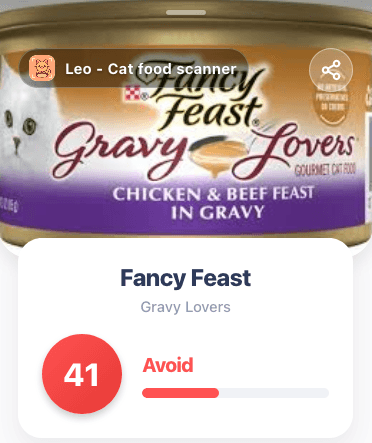
What the app flagged
Carrageenan
Wheat gluten
Modified corn starch
Artificial and natural flavorings
This one leaned heavily into the classic thick gravy texture, which also meant stacking multiple texture-related additives together in the same formula.
Wellness Complete Health Chicken Entrée
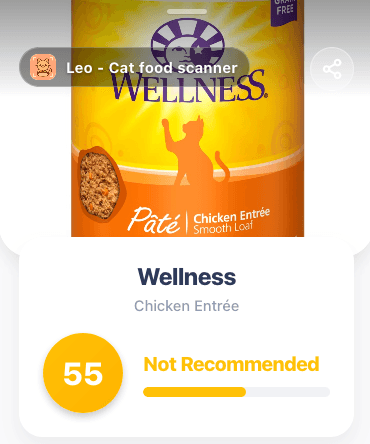
What the app flagged
Carrageenan
Guar gum
Cassia gum
This was one of the more interesting scans because the branding feels very “clean” and health-focused, yet carrageenan still showed up alongside multiple thickening gums.
Friskies Extra Gravy Paté
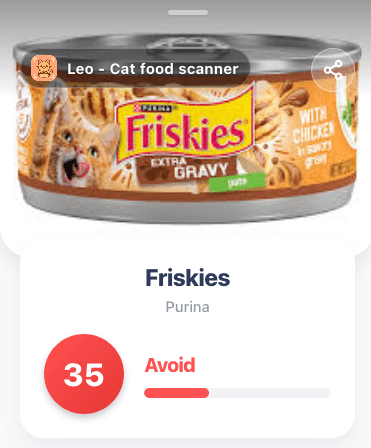
What the app flagged
Carrageenan
Modified starches
Artificial flavorings
Multiple thickening agents
No huge surprise here, gravy-heavy formulas were some of the most common places carrageenan kept appearing during scans.
You can see a full breakdown in our Friskies cat food review.
So… Should You Avoid Carrageenan?
If your cat is perfectly healthy, occasional carrageenan probably isn’t the end of the world.
But if you’re already dealing with digestive issues, food sensitivities, or you simply prefer cleaner ingredient lists, it’s understandable why many cat owners choose to avoid it.
At the very least, carrageenan is one of those ingredients worth being aware of, especially since it tends to show up alongside a lot of heavily processed texture-focused formulas.
Carrageenan is far from the only controversial ingredient showing up in cat food formulas.
Here are some other cat food ingredients to avoid if you’re trying to clean up your cat’s diet.
Want to check whether your own cat food contains carrageenan or other controversial additives?
You can scan cat foods directly in the app to check:
- ingredient quality
- controversial additives
- thickening agents and fillers
- protein sources
- overall nutrition score