
Guar Gum in Cat Food: We Checked 75 U.S. Brands. Here’s What We Found
Guar gum shows up in far more cat foods than you might expect. We checked 75 U.S. brands, compared real formulas and looked at the feline research to find out when this common thickener actually matters.
Guar Gum in Cat Food: We Checked 75 U.S. Brands. Here’s What We Found
Guar gum in cat food. I know, you're probably here after seeing all those ongoing debates online. Now you end up spending your time in grocery stores reading through ingredient lists, desperate to find out whether there is guar gum in that recipe or not.
Don't worry, we checked it for you. We looked at 75 cat food brands currently sold in the United States, using real products and ingredient lists already analyzed through cat food scanner Leo scans.
52 of those brands used guar gum in at least one formula. That’s 69.3% — roughly 7 in 10 brands.
Surprisingly, Guar gum didn't only show up in supermarket brands as you may have expected. We found it in premium foods and even products marketed around digestive health.
Now, the better question might be: does finding guar gum on an ingredient list actually tell you anything useful about the quality of the food?
It Isn’t Just Something Used by Cheap Cat Food Brands
This article would have been easier to write if I just had to tell you it's only used in low-cost cat food. It isn't.
Take Purina ONE Grain Free Chicken Wet Cat Food. The current U.S. ingredient list includes guar gum. Same thing for its Grain Free Turkey recipe.
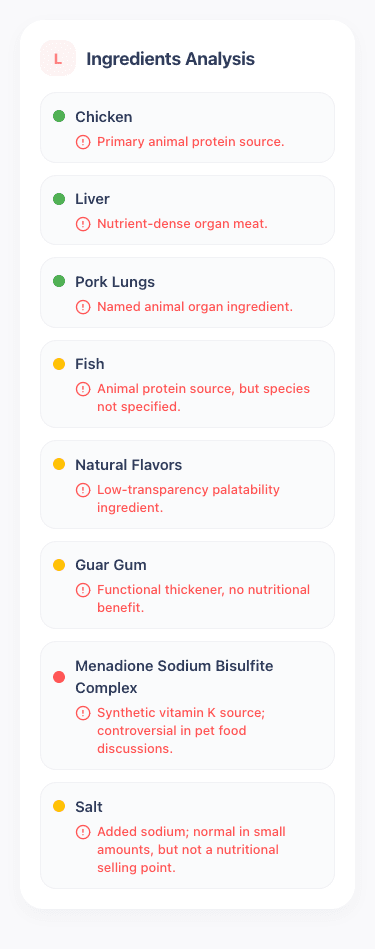
Now look at Royal Canin Digestive Care Loaf in Sauce. This wet food specifically positioned around digestive health, and its U.S. formula also contains guar gum, alongside carrageenan and other functional ingredients.
Now, keep in mind that its presence tells very little about the overall quality of the recipe by itself. And that’s exactly the sort of distinction our scanning results try to make visible.
Two foods can both contain guar gum and still look completely different once you analyze the rest of the ingredient list.
Why Do So Many Wet Cat Foods Use Guar Gum?
Let's be honest, they don't add it for the fun of it, but because it makes the product easier to formulate. Wet cat food contains water, fat and meat solids that can separate during processing and storage. Guar gum absorbs water and acts as a thickener and stabilizer, so the texture ends up looking better.
The FDA even recognizes guar gum for technological uses including thickening, stabilizing and texturizing.
And that distinction matters: guar gum is useful to the formulation, not nutritionally necessary for your cat.
The Cat Study We Think Is Actually Worth Paying Attention To
Ok, now this is the interesting part. We know that it's not nutritionally necessary for your cat but is it bad ?
One study published in the British Journal of Nutrition actually investigated guar gum in domestic cats.
Ten cats received diets supplemented with either guar gum or cellulose in a crossover design. The mean apparent protein digestibility was 71.8% on the guar-gum-supplemented diet versus 79.7% with cellulose.
That difference had a P-value of 0.07, meaning it did not meet the conventional threshold for statistical significance, although the researchers described protein digestibility as tending to be lower with guar gum (as you can see from the purcentages above).
But let's be precise here, that roughly 8% gap does not prove that a commercial pâté containing a small amount of guar gum near the end of its ingredient list reduces protein digestibility by eight percentage points.
The study tested a deliberately supplemented diet under controlled conditions. Commercial foods use different quantities, combinations and formulations.
I know, it would have been better for a Tiktok headline to conclude that guar gum is dangerous, but the truth is there is enough cat-specific evidence for us not to dismiss the ingredient as completely irrelevant, but nowhere near enough to treat its presence as an automatic reason to reject a food.
Where Does Leo Draw the Line With Guar Gum?
What matters the most is the whole ingredient list. This is the reason we don't think ingredient blacklists are particularly helpful.
We would not reject an otherwise strong wet food solely because it contains guar gum.
Imagine scanning two foods and finding guar gum in both. One could have clearly named meat ingredients, a strong nutritional profile and very few other additives.
The second could combine guar gum with several other thickeners, vague animal ingredients, artificial colors and a much less transparent formula.
Giving both foods the same verdict because they share one ingredient would make no sense.
Here are two great examples that demonstrate the point instead of just telling you. Both contain guar gum.
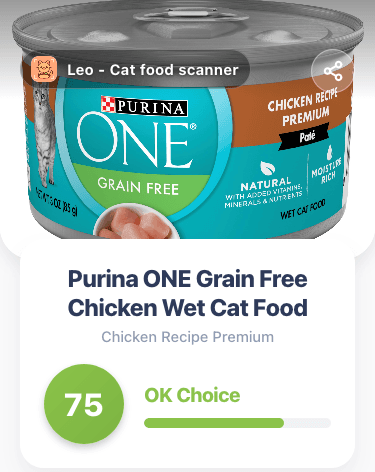
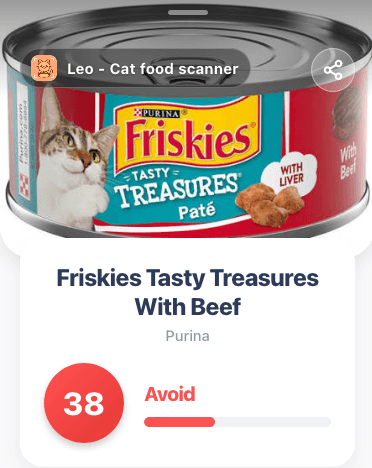
Now if we're comparing two similar foods, we'd generally choose the simpler formula with fewer unnecessary gums. And depending on your cat's profile, we'd pay more attention to guar gum in cats with recurring digestive sensitivity, particularly if symptoms repeatedly appear with foods containing similar combinations of thickeners and rate that food accordingly.
So, Should Guar Gum Worry You?
After checking 75 brands, looking at real formulas and digging into the feline research, we wouldn't make guar gum the ingredient that decides whether we buy a cat food.
It's extremely common, nutritionally unnecessary and worth paying attention to — particularly for sensitive cats — but it isn't enough on its own to turn a good recipe into a bad one.
What interests us much more is what happens when guar gum appears alongside everything else in the bowl.
And that's exactly why we built cat food scanner Leo in the first place.