
Ash in Cat Food: We Checked 100 U.S. Products. Here’s What We Found
Ash in cat food is often misunderstood. We checked 100 U.S. cat foods to see how often brands disclose ash, how wet and dry foods compare, and what the number actually tells you.
Ash in Cat Food: We Checked 100 U.S. Products. Here’s What We Found
Ash in cat food has been the subject of a lot of debate and this make sense. I mean the name is alarming, but what it actually measures is much less dramatic.
We took the the 100 most-scanned cat foods (50 wet foods and 50 dry foods) in our app in the United States.
Out of the 100 cat foods we checked, 54 disclosed their total ash content and 46 didn’t. Wet foods were much more transparent in our sample, with 40 out of 50 listing ash, compared with just 14 out of 50 dry foods.
And there are in their own right. According to the AAFCO, total ash isn't one of the four basic guarantees manufacturers are required to include.
What Is Ash in Cat Food?
Way simpler than people make it for. Ash is just a measurement of the mineral content left after the organic material in a food is burned away during laboratory analysis.
It can include minerals such as calcium, phosphorus, magnesium, potassium, sodium and trace minerals. So “ash” isn't one ingredient being added to your cat's food; it's a rough measurement that groups multiple minerals together.
Two Cat Foods, Two Completely Different Levels of Transparency
As mentionned above, when we checked 100 cat foods amongst those we scanned, we found different approaches to ash. Some foods gave us a clear total ash figure alongside the usual protein, fat, fiber and moisture values
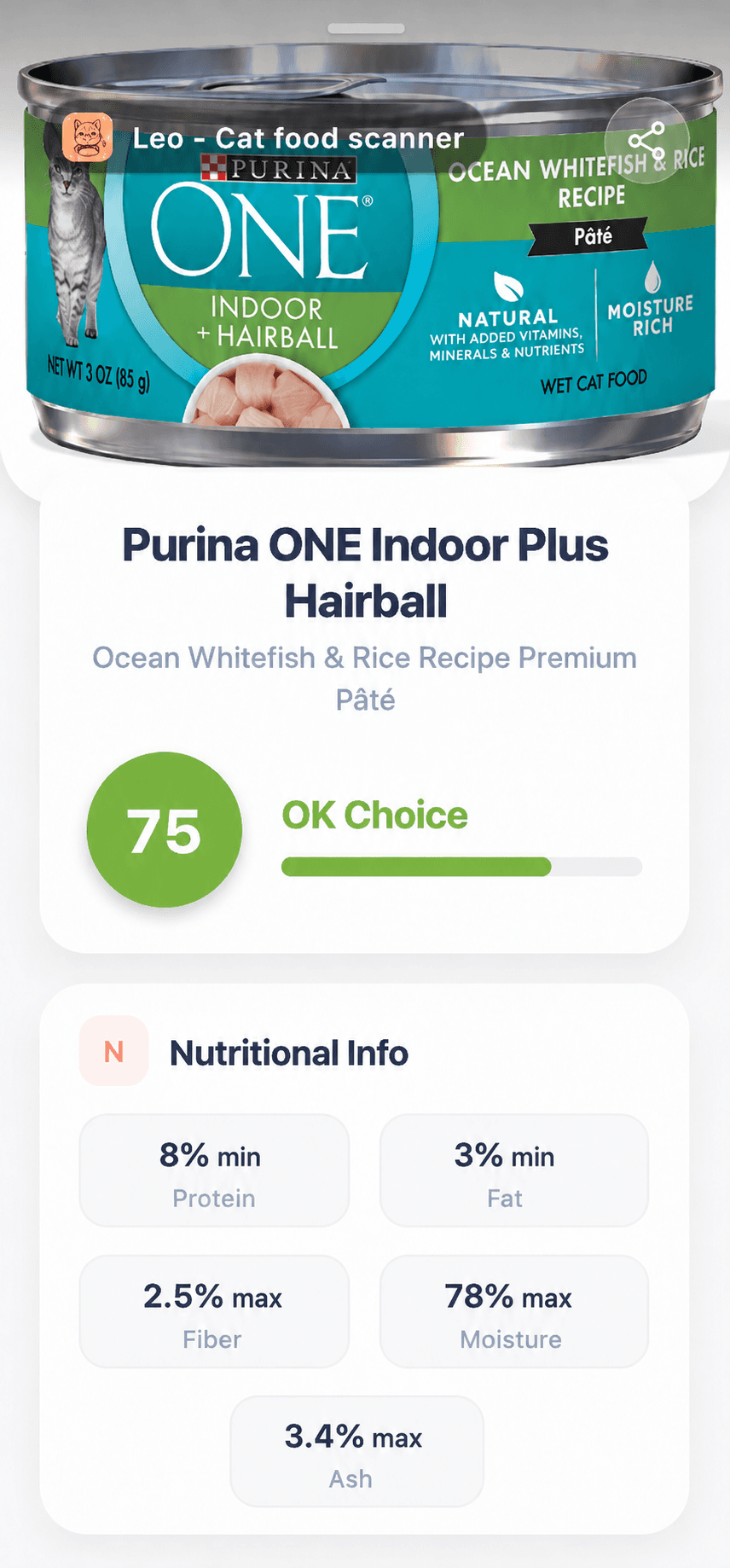
For example, Purina ONE Indoor Plus Hairball Ocean Whitefish & Rice Recipe Premium Pâté was one of the products in our sample for which a total ash maximum was published.
And now one example of foods where we could find protein, fat, fiber, moisture and other nutritional information, but no total ash figure.
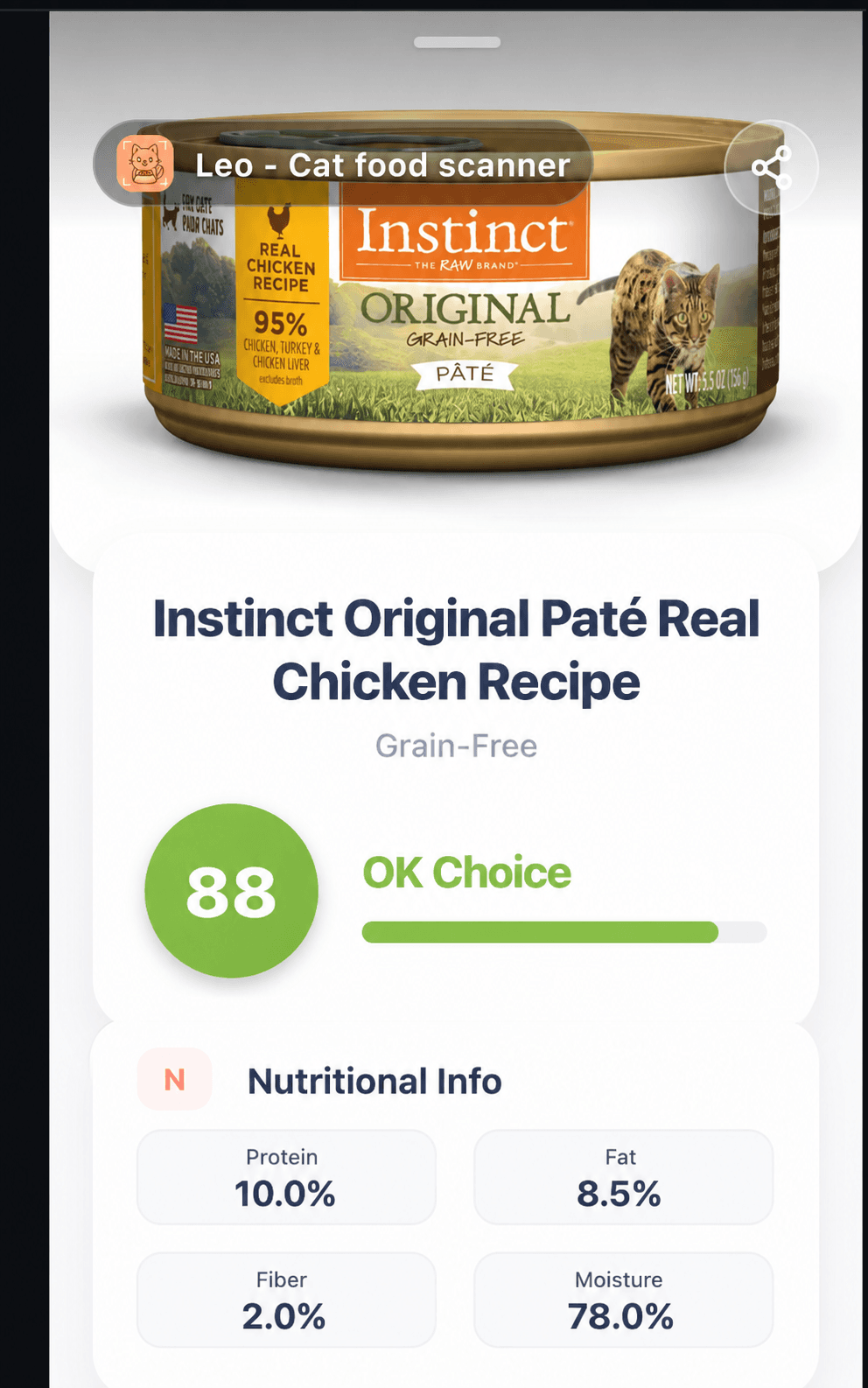
Here as you can see, Instinct Original Paté Real Chicken Recipe fell into that second group in the manufacturer information we reviewed.
All of that to say: before asking whether an ash percentage is high or low, there's a more basic problem: you may not be given the number in the first place.
“3% Ash Max” Doesn't Mean the Food Contains Exactly 3%
Another detail we should keep in mind in this, is that most of the ash figures we found were maximum guarantees.
If a label says: Ash: 3% max that isn't the same thing as saying: This food contains exactly 3% ash.
Again, AAFCO explains that guarantees are declared as minimums or maximums rather than serving as exact measurements of every batch. Its model regulations also specify that when ash is listed as a guarantee, it is expressed as a maximum percentage.
Why Wet and Dry Ash Numbers Can Be Misleading
In our sample, wet cat foods showed an average maximum ash level of 2.64%, compared with 8.51% for dry cat foods.
It looks like the dry food contains four times as much, but those percentages are given as fed, meaning the water in the food is still part of the calculation.
So obviously, wet food naturally shows lower nutrient percentages because so much of it is water.
So, Is High Ash Content Bad for Cats?
Answer is no. As said above, ash is a measurement of total mineral content. Thing is, It doesn't tell you how that total is divided between calcium, phosphorus, magnesium and the other minerals contributing to it.
And those individual mineral profiles really can vary between commercial cat foods.
A 2020 study analyzed phosphorus, calcium and magnesium concentrations in commercially available cat foods and found substantial variation across products and food formats. The researchers evaluated those minerals individually rather than treating “ash” as a substitute for the entire mineral profile.
That matters because two foods could show the same total ash percentage while containing different amounts of the individual minerals behind that number.
So the more useful question would be which minerals are present, in what amounts, and how they fit into the complete formulation.
That's also why we wouldn't give a food a poor score simply because one ash percentage looked high.
What About Ash, Magnesium and Urinary Crystals?
Now this is where ash got much of its bad reputation. Struvite is one of the important types of urinary stones seen in cats, and struvite is magnesium ammonium phosphate.
So magnesium does have a relationship with struvite, but this isn't enough to make total ash a direct measurement of urinary-stone risk. Because again, if a food reports 8% total ash, that number doesn't tell you how much of the 8% is magnesium. Don't forget that ash combines several minerals into a single measurement.
Urinary problems also depend on other factors, especially urine pH, mineral balance and the type of crystals or stones involved.
If your cat already has urinary problems or a history of stones, the right diet depends on the specific condition and should be discussed with a veterinarian.
So Should You Look for Low-Ash Cat Food?
For a healthy cat, I wouldn't choose food based on the lowest ash percentage alone.
After going through 100 products, there are simply too many problems with using it that way.
A published ash value could be:
a maximum guarantee rather than an exact amount;
an as-fed number heavily affected by moisture;
or a total that tells you nothing about how much calcium, phosphorus or magnesium contributed to it.
So if ash is available, I'd look at it like that:
how much moisture the food contains;
whether the number is a maximum guarantee or typical analysis;
whether individual minerals such as calcium, phosphorus or magnesium are published;
and what the rest of the nutritional and ingredient profile looks like.
That's much more useful (but much more longer and annoying) than trying to turn one percentage into a universal good/bad cutoff.
Want to Check Your Cat's Food?
Reading one cat-food label isn't too difficult in itself. But trying to compare several foods across their ingredients, additives, protein sources, carbohydrates and nutritional information gets complicated very quickly.
That's part of why I built Cat Food Scanner Leo.
You can scan your cat's food and Leo breaks down the formula so you can see what's actually inside instead of trying to judge the entire product from one ingredient or one percentage.
Sources
Association of American Feed Control Officials (AAFCO) — Nutritional Labeling. Explains required Guaranteed Analysis values, voluntary additional nutrient guarantees and the distinction between minimum and maximum guarantees.
AAFCO — Model Regulations for Pet Food and Specialty Pet Food. Specifies that when ash is included as a guarantee, it is expressed as a maximum percentage.
AAFCO — Dog and Cat Food Nutrient Profiles. Provides feline nutrient profiles on a dry-matter basis and treats minerals such as calcium, phosphorus and magnesium individually.
Tufts University, Cummings School of Veterinary Medicine — “All About Ash.” Veterinary nutrition overview of what ash measures and why total ash alone has limited usefulness when evaluating pet food.
Summers SC et al. (2020) — Evaluation of phosphorus, calcium, and magnesium concentrations in commercially available foods formulated for healthy cats. Analysis of individual mineral concentrations across commercial cat foods.
Tarttelin MF et al. (1987) — Feline struvite urolithiasis: factors affecting urine pH may be more important than magnesium levels in food. Experimental study examining dietary magnesium, urine pH and struvite crystalluria in cats.
Morris EM et al. (2023) — Relative supersaturation values distinguish between feline urinary and non-urinary foods. Study examining urine pH, struvite relative supersaturation and urinary crystals in cats fed different diets.
Merck Veterinary Manual — Urolithiasis in Cats / Overview of Urolithiasis in Small Animals. Veterinary reference on feline struvite and other uroliths, urinary mineral concentrations, pH and dietary management.